
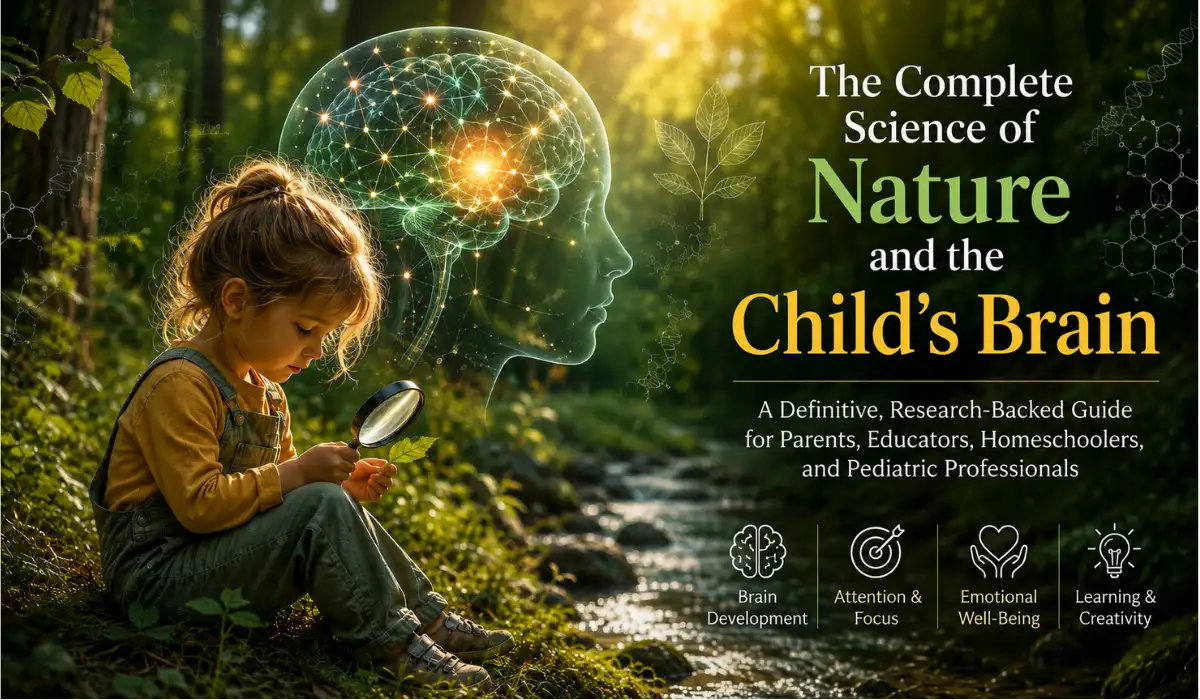
A Definitive, Research-Backed Guide for Parents, Educators, Homeschoolers, and Pediatric Professionals
Published by Ecolabs at raniyer.com | Written by Rani Iyer, Author & Ecologist
“In every walk with nature, one receives far more than he seeks.” John Muir
How to Use This Guide
This guide is designed to function on multiple levels simultaneously.
For parents: Read Section 1 (The Architecture of a Nature-Ready Brain), then jump to Section 13 (Practical Activities by Age) for immediate, actionable steps. The research sections in between give you the vocabulary to talk about this with teachers, pediatricians, and other parents.
For teachers and homeschoolers: Sections 2, 7, 8, and 11 which covers executive function, creativity, language, and academic achievement and speak most directly to classroom application. The Master Research Summary Table (Section 12) is a quick-reference for professional development discussions or curriculum committee presentations.
For pediatric professionals: Section 14 is written specifically for you, with clinical framing. The Master Research Summary (Section 12) provides the citation density needed for evidence-based practice guidance.
For journalists: This guide is organized to provide paragraph-ready research citations across each domain. Every factual claim is traced to its source, and URLs are provided in the References section.
For everyone: The Practical Activities section (Section 13) is the heart of everything. Science is only as valuable as the actions it inspires.
A note on citations: where research is directly cited in the body of this text, the source is identified in brackets. A complete reference list appears in Section 15. Where statistics or findings are widely replicated across multiple studies, the most rigorous available source is cited.
Why This Guide Exists, and Why It Matters More Than Ever
Something quietly extraordinary happens when a child crouches beside a mud puddle, watches a caterpillar inch across a leaf, or lies in the grass tracing cloud shapes overhead. The adults nearby might see simple play. Neuroscience sees a brain in full bloom.
Over the past three decades, researchers across fields as varied as cognitive neuroscience, environmental psychology, pediatric medicine, and ecology have assembled a body of evidence that is both thrilling and sobering: the natural world is not just a nice backdrop for childhood. It is, in a profound biological sense, the environment the child’s brain was built to grow inside.
This guide compiles and synthesizes the best of that research. It is written for parents who want the “why” behind outdoor play, for teachers and homeschoolers who need research justification for nature-based learning, for pediatric professionals looking for accessible summaries to share with families, and for journalists seeking a credible, citation-rich resource on one of education’s most important emerging conversations.
We cover twelve domains: executive function, ADHD, stress hormones, dopamine, memory, creativity, language, emotional regulation, sleep, and academic achievement, concluding with a practical, age-by-age activity guide any family can start today.
Table of Contents
- The Architecture of a Nature-Ready Brain
- Nature and Executive Function
- ADHD and Green Spaces
- The Cortisol Story: How Nature Quiets the Stress Response
- Dopamine vs. Digital Stimulation
- Memory Formation in Natural Environments
- How Nature Sparks Creativity
- Language Development Under Open Skies
- Emotional Regulation: The Nervous System’s Nature Prescription
- Sleep, Melatonin, and the Outdoor-Indoor Divide
- Academic Achievement: When Green Space Meets Test Scores
- Master Research Summary Table
- Practical Activities by Age (0–12+)
- A Note for Pediatric Professionals
- References
1. The Architecture of a Nature-Ready Brain
To understand why nature affects children so powerfully, we first need to appreciate what a child’s brain actually is in its earliest years: a prediction machine desperately hungry for input.
From birth through approximately age seven, the human brain undergoes its most intense period of synaptogenesis — the explosive formation of neural connections. The brain is not pre-programmed with knowledge; it sculpts itself in response to the environment it encounters. This is what neuroscientists call experience-dependent neuroplasticity, and it means that the quality and variety of early sensory experience literally shapes the brain’s physical architecture.
For millions of years of human evolution, that formative sensory environment was nature. Rustling grasses, shifting wind, the uneven terrain of forest floors, birdsong at different pitches and distances, the visual complexity of canopy light filtering through leaves… these were the inputs the developing brain came to expect. They are, in the most literal sense, what it was built to process.
Modern indoor environments, by contrast, offer a narrowed sensory palette: flat floors, consistent temperatures, controlled light, and the rapid, high-contrast stimulation of screens. These are not inherently harmful, but they represent a radical departure from the biological norm the one that growing evidence suggests carries real developmental costs.
Brain-derived neurotrophic factor (BDNF), sometimes called “Miracle-Gro for the brain,” is a protein that promotes the growth, maintenance, and survival of neurons. Physical activity in natural settings which is the kind that involves irregular surfaces, varied pacing, and genuine exploration, has been shown to significantly upregulate BDNF expression in children, supporting the neural growth that underlies learning, memory, and emotional resilience. This neurobiological mechanism is one of the clearest explanations for why outdoor time isn’t supplemental to child development- it is child development.
2. Nature and Executive Function
What Is Executive Function, and Why Do Pediatricians Care?
Executive function (EF) is the family of cognitive skills that allows a person to plan, focus attention, remember instructions, manage competing demands, and juggle multiple tasks simultaneously. The prefrontal cortex, the brain’s strategic headquarters, houses these capacities, and it continues developing well into the mid-twenties.
In children, strong executive function predicts not just academic success but life outcomes: lower rates of mental health difficulties, better social relationships, and even long-term physical health. Executive function is, many developmental scientists now argue, a better predictor of school readiness than IQ.
What the Research Shows
A 2017 landmark study by Schutte, Torquati, and Beattie, published in Environment and Behavior, examined the impact of urban nature exposure on executive functioning in early and middle childhood. The study found that proximity to natural settings, even views of greenery through windows, was associated with measurable improvements in children’s attention and working memory performance.
A comprehensive 2024 systematic review and meta-analysis published in the Journal of Environmental Psychology, examining 34 experimental studies, found small but statistically significant positive effects of nature exposure on attention and executive functioning outcomes in children and adolescents. Crucially, the analysis showed that longer-duration nature interventions produced stronger effects than brief exposures, suggesting cumulative benefits for children with regular outdoor time. [Source: ScienceDirect, Benefits of nature exposure on cognitive functioning in children and adolescents, 2024]
The mechanism appears to involve what psychologists Rachel and Stephen Kaplan call Attention Restoration Theory (ART). The Kaplans propose that directed attention, the effortful, voluntary focus we use for tasks, is a finite cognitive resource that fatigues with use. Natural environments, they argue, engage an involuntary, effortless fascination that allows directed attention to replenish. A child who has spent forty-five minutes engaged in unstructured outdoor play is, neurologically speaking, rested with better ability to sit, focus, and learn.
Research reviewed by Chawla (2015) showed that greater access to and time spent in outdoor and green spaces is positively associated with higher concentration, greater self-control, and increased memory performance in children. A particularly notable finding came from Mårtensson and colleagues (2009), who found that preschool children who spent more time outdoors in “green, spacious, and well-integrated” outdoor areas had significantly higher attention and ability to focus than peers in more restricted settings. [Source: Informal Science, informalscience.org]
The Loose Parts Principle
Open-ended natural environments: places where sticks, stones, mud, water, and leaves can be freely reconfigured are especially potent for executive function development. Loose parts play, as coined by architect Simon Nicholson, presents children with problems that have no single solution, requiring them to plan, test hypotheses, revise, and persist. This is executive function training in its most organic, intrinsically motivated form.
3. ADHD and Green Spaces
Attention Deficit Hyperactivity Disorder: A Landscape Problem?
Attention-deficit/hyperactivity disorder affects an estimated 5–9% of school-aged children worldwide and is primarily managed through medication and behavioral therapy. But a compelling and growing body of research suggests that the natural environment may offer a meaningful complementary, and in some cases, preventive, influence.
The Danish Cohort Study
One of the most powerful datasets in this field comes from a nationwide cohort study published in Environmental Health Perspectives. Researchers tracked 814,689 children born in Denmark between 1992 and 2007, following them for a clinical diagnosis of ADHD from age five. They used the Normalized Difference Vegetation Index (NDVI) a satellite measure of greenness surrounding each child’s home, to quantify nature exposure.
The findings were striking: children who grew up with lower levels of residential greenness in their first five years of life had significantly higher rates of ADHD diagnosis, even after controlling for socioeconomic factors, parental education, and urban density. The association was consistent and dose-dependent as the greener the childhood environment, the lower the risk. [Source: PMC/NCBI, The Association between Residential Green Space in Childhood and Development of Attention Deficit Hyperactivity Disorder, 2020]
The 2024 Systematic Review
A June 2024 systematic review published in the International Journal of Environmental Research and Public Health examined the totality of evidence on nature exposure and ADHD. Researchers concluded that the reviewed literature “suggests an overall favorable effect of exposure to nature on ADHD,” while noting that varied definitions of “nature exposure” across studies make direct comparisons challenging. The review highlighted walk-in-nature interventions, school green space studies, and residential greenness analyses as consistently pointing in the same direction: green is good for the ADHD brain. [Source: MDPI, Could Nature Contribute to the Management of ADHD in Children?, June 2024]
A 2022 Systematic Review of 29 Studies
A systematic review published in Science of the Total Environment examined 29 studies on the association between long-term greenspace exposure and behavioral problems in children. The review found that “total behavioral difficulties and ADHD showed consistent associations with greenspace” making it one of the most robust meta-findings in this field. [Source: ScienceDirect, Greenspace exposure and children behavior, 2022]
Why Might Nature Help ADHD Brains?
Several mechanisms have been proposed:
Attention Restoration: As with typically developing children, the involuntary attention nature engages allows the depleted directed-attention system to recover. For children with ADHD, whose directed attention reserves are chronically strained, this restoration may be particularly therapeutic.
Cortisol and Stress Reduction: (Explored in depth in the next section.) Lower chronic stress appears to reduce ADHD symptom severity.
Physical Movement: Natural environments encourage physical activity that is varied and self-directed rather than prescribed, which research suggests is particularly effective for the ADHD nervous system.
Reduced Sensory Overload: Nature’s stimulation is softer, patterned, and fractal mathematically self-similar at different scales, which neuroscience research suggests the brain finds inherently calming.
A Word of Caution
Nature is not a replacement for evidence-based ADHD treatment. Families should work with their pediatrician or child psychiatrist. The evidence reviewed here is compelling, but most studies are observational. Nature time is best thought of as a powerful complementary support as it is low cost, zero side effects, and accessible to most families in some form.
4. The Cortisol Story: How Nature Quiets the Stress Response
Chronic Stress and the Developing Brain
Cortisol is the body’s primary stress hormone, produced by the adrenal glands in response to perceived threat. In acute, short-lived doses, cortisol is adaptive as it sharpens attention and mobilizes energy. But chronic cortisol elevation is profoundly damaging to the developing brain.
Elevated cortisol in childhood has been linked to impaired hippocampal development (the hippocampus is the brain’s memory center), disrupted prefrontal cortex function (impairing decision-making and emotional control), and long-term changes in how the stress response system is calibrated — creating a nervous system that is chronically “on alert.”
Urban environments, with their noise, crowding, unpredictability, and sensory intensity, tend to produce persistently elevated cortisol profiles in children. Early childhood trauma compounds this further. The result is a brain operating in a state of biological emergency which are poor conditions for the curiosity, creativity, and focus that learning demands.
Nature as a Cortisol Modulator
The evidence that natural environments reduce cortisol is substantial. A systematic review of more than 40 experimental studies found that “measures of heart rate, blood pressure, and perceived stress provide the most convincing evidence that exposure to nature or outdoor environments may reduce the negative effects of stress.” [Source: PMC/NCBI, Associations between Nature Exposure and Health, 2021]
A 2017 study examining children in regular outdoor education programs found evidence of healthier cortisol rhythm regulation compared to control groups suggesting that consistent nature time helps calibrate the body’s stress response system, not just reduce stress in the moment. [Source: The Neuroscience of Outdoor Learning, yourleapforward.com, 2026]
Gidlow and colleagues (2016), studying hair cortisol (a measure of chronic stress over months rather than hours), found that residential proximity to natural environments was associated with lower long-term cortisol levels — a finding with significant implications for childhood development.
The School Classroom Window
A fascinating 2023 study published in Behavioral Sciences examined how classroom size and window views of nature interacted with children’s cortisol levels to affect executive function in preschoolers. Using virtual reality simulations to control variables, the researchers found that nature views moderated the relationship between cortisol and cognitive performance. Children with elevated baseline cortisol performed significantly better on executive function tasks when exposed to natural views. In other words, nature exposure may be especially cognitively protective for the most stressed children. [Source: NCBI, The Moderating Role of Cortisol and Negative Emotionality, 2023]
This has immediate, practical implications for classroom design and school policy.
5. Dopamine vs. Digital Stimulation
The Dopamine Economy of Childhood
Dopamine is a neurotransmitter involved in motivation, reward, and the anticipation of pleasure. It is popularly (if somewhat imprecisely) described as the brain’s “feel-good chemical,” but its actual function is more nuanced: dopamine is less about pleasure itself than about the prediction of reward. It fires in anticipation, teaching the brain what to seek more of.
How Digital Screens Hack the Reward System
Modern digital experiences- social media, video games, streaming platforms, and app-based entertainment- are engineered to exploit the dopamine system with unprecedented precision. Variable reward schedules (the same mechanism that makes slot machines addictive), infinite scroll, notification pings, and level-up mechanics are all designed to produce rapid, frequent dopamine spikes.
The problem for developing brains is not dopamine itself, but the calibration of the reward system. When a child’s brain is repeatedly exposed to rapid, high-intensity dopamine hits from screens, real-world rewards such as watching a butterfly emerging from a chrysalis, the satisfaction of building a dam in a stream, the delayed gratification of watching a seed sprout and begin to feel underwhelming by comparison. The reward threshold rises.
Research indicates that excessive screen time creates a cycle of dependency and withdrawal, and that the dysregulation of dopamine may be more damaging to mood, anxiety, and sleep than even the sleep disruption caused by blue light. [Source: Philadelphia Integrative Psychiatry, The Impact of Social Media and Video Games on Dopamine Regulation, 2024]
An analysis published in the journal Children’s Health in the Digital Age (2020) noted that excessive indoor screen time is likely to have a negative effect on a variety of dopamine-dependent behaviors, and that melatonin which is the sleep hormone produced during outdoor exposure and natural darkness, plays an important role in modulating dopamine release in the brain. Disrupting melatonin production through excessive artificial light therefore cascades into disrupted dopamine regulation. [Source: arXiv, Children’s Health in the Digital Age, 2020]
What Nature’s Dopamine Looks Like
Nature offers dopamine too, but through a fundamentally different mechanism. Discovery is inherently unpredictable and intrinsically motivated. A child who has been searching through leaf litter for beetles receives a genuine reward signal when she finds one but the reward is earned through sustained attention, hypothesis-testing, and patience. These are the conditions under which healthy dopamine calibration is maintained.
The neuroscience of play suggests that open-ended, exploratory activity produces what researchers call a “dopamine drip” is a steady, moderate release associated with curiosity and exploration, rather than the sharp spikes produced by engineered digital rewards. This drip is associated with states of flow, sustained engagement, and intrinsic motivation: precisely the motivational qualities children need to become successful learners.
Critically, the expanding body of research suggests the goal is not to eliminate digital experiences but to ensure that nature’s slower, richer rewards remain a dominant part of children’s sensory diet preventing the upward calibration of the reward threshold that makes real-world experience feel flat.
6. Memory Formation in Natural Environments
How Memories Are Made
Memory formation is not a passive recording process. The hippocampus which is the brain’s primary memory-consolidation center is particularly responsive to novelty, emotional salience, and multi-sensory richness. Experiences that engage multiple senses simultaneously, carry an emotional charge, and occur in novel contexts are encoded far more strongly than rote, passive information delivery.
Natural environments are, by their nature, multi-sensory, novel, and emotionally engaging. The child who learns about the water cycle while building a dam in a stream encodes that knowledge in a fundamentally different neurological way than the child who watches a diagram on a whiteboard.
BDNF and the Memory-Exercise Connection
Physical activity in natural settings significantly elevates brain-derived neurotrophic factor (BDNF), which directly supports hippocampal neurogenesis the growth of new neurons in the memory center. Research increasingly confirms that learning experiences combined with physical movement, especially in varied outdoor environments, produce stronger memory consolidation than sedentary indoor instruction. [Source: yourleapforward.com, The Neuroscience of Outdoor Learning, 2026]
This is why the same information taught in an outdoor classroom setting often produces stronger recall than identical content taught indoors: the embodied, kinesthetic, emotionally resonant nature of the outdoor experience creates richer memory traces.
Novel Outdoor Experiences Create Strong Neural Connections
As summarized in research from early childhood educators, novel outdoor experiences create particularly strong memories and neural connections that support learning precisely because novelty itself drives the hippocampus to encode more deeply. [Source: kidzeekasavanahalli.com, The Power of Outdoor Play, 2025]
The practical implication is significant: a field trip, a gardening project, or a stream study session is not supplementary to “real” learning. It may be among the most neurologically efficient forms of learning available to children.
7. How Nature Sparks Creativity
The Creative Brain and Nature’s Unstructured Canvas
Creativity, the capacity to generate novel ideas, make unexpected connections, and think divergently, is among the most valued human qualities and one of the most difficult to nurture in structured environments. The human brain’s default mode network (DMN), which activates during mind-wandering and imaginative thinking, is paradoxically most active during periods of relaxed, non-directed attention.
Screens and structured indoor activities tend to collapse the DMN by providing constant directed stimulation. Nature, by contrast, provides what might be called undirected sensory richness input that is complex and interesting enough to sustain attention, but not so directive as to prevent imaginative elaboration.
The Research on Creativity Outdoors
Studies of children in schoolyards have consistently found that they engage in more creative and cooperative forms of play in naturalized outdoor spaces compared to conventional asphalt playgrounds. A summary from the Natural Learning Initiative reports that “play in nature is especially important for developing capacities for creativity, problem-solving, and intellectual development.” [Source: naturalearning.org, Benefits of Engaging Children with Nature]
Research reviewed by the National Wildlife Federation found that 75 percent of educators believe students who spend regular time outdoors are more creative and better able to problem-solve in the classroom. [Source: naturalplaygrounds.com, Outdoor Time Boosts Academic Performance]
The neuroscience aligned with these observations: unlike highly structured indoor environments, outdoor spaces are dynamic and unpredictable. A stick becomes a musical instrument, a bridge, or a fishing rod. A puddle becomes an engineering challenge. A garden plot becomes a science laboratory. These open-ended, self-directed transformations are precisely the cognitive operations flexible thinking, analogical reasoning, imaginative projection that define creative intelligence. [Source: yourleapforward.com, The Neuroscience of Outdoor Learning, 2026; greatbeginningsmonterey.com, How Nature-Based Play Supports Brain Development, 2025]
The Four-Day Effect
In a widely cited 2012 study by Atchley, Strayer, and Atchley published in PLOS ONE, participants who spent four days on a wilderness backpacking trip with no digital technology showed a 50% improvement in creative problem-solving tasks. While this study focused on adults, its implications for children are clear: extended immersion in natural settings without digital interruption may significantly enhance creative cognitive capacity. For children, who spend far more waking hours in nature-deprived digital environments than adults, the potential gains from reversal are likely even greater.
8. Language Development Under Open Skies
Nature as a Vocabulary Builder
Language development in young children is profoundly experience-dependent. Children acquire vocabulary most effectively not through instruction but through immersion in rich, varied, conversational contexts in which new words are embedded in memorable, meaningful experience. Natural environments are uniquely efficient generators of exactly these conditions.
A child who watches a spider construct a web and asks “What’s that called?” and is told it’s an “orb weaver” building its “spiral-bound web” is receiving vocabulary instruction in its most neurologically optimal form: anchored to multi-sensory experience, emotionally salient (spiders are fascinating), and contextually rich.
Research on outdoor language play highlights significant developmental enhancements when children have access to “wildlife interaction, art, outdoor reading, and language play” in nature-based settings. These improvements indicate that outdoor environments purposefully incorporating educational and creative activities promote comprehensive language development. [Source: PMC/NCBI, Effective Nature-Based Outdoor Play and Learning Environments, 2024]
One particularly striking anecdote in the research literature: a parent reported that their child, who began nature play sessions at age two with very limited vocabulary, became “very talkative” within a few months of regular outdoor exposure. While anecdotal, this observation is consistent with the broader literature showing that nature’s multi-sensory richness provides the experiential scaffolding on which vocabulary grows most rapidly. [Source: greatbeginningsmonterey.com, How Nature-Based Play Supports Brain Development, 2025]
Narrative, Story, and the Natural World
Storytelling is one of the oldest and most cognitively demanding language activities, emerges naturally and abundantly in outdoor play. Children who play in naturalized settings spend significantly more time in what researchers call “socio-dramatic play”: narrative-rich, imaginative scenarios in which they collaborate on story worlds, negotiate rules and roles, and sustain extended dialogue.
This kind of play is a workout for every dimension of language: syntax (constructing complex sentences), semantics (deploying vocabulary precisely), pragmatics (negotiating meaning in social context), and narrative structure (beginning, middle, end- cause, consequence, resolution). Schools using outdoor classrooms have observed significant student gains in language arts alongside other subject areas. [Source: naturalearning.org, Benefits of Engaging Children with Nature]
9. Emotional Regulation: The Nervous System’s Nature Prescription
What Is Emotional Regulation, and Why Does It Matter?
Emotional regulation is the capacity to manage one’s emotional responses to feel a feeling without being overwhelmed by it, and to return to a calm baseline after disruption. It is among the most important skills a child will ever develop, underpinning healthy relationships, mental health, and learning.
The brain’s emotional regulation circuitry involves a dynamic relationship between the amygdala (the brain’s threat-detection center) and the prefrontal cortex (the brain’s rational override system). When the amygdala is overactivated by chronic stress, the prefrontal cortex’s regulatory capacity is compromised. Children in chronically stressful environments including environments of sensory overload, unpredictability, and screen-induced hyperarousal, therefore show impaired emotional regulation not because of any character flaw, but because of brain biology.
How Nature Calms the Amygdala
Natural environments appear to downregulate amygdala activity through multiple pathways: they reduce cortisol (as discussed above), provide low-level sensory richness that engages the parasympathetic nervous system, and create conditions for unstructured, self-directed play that supports intrinsic emotional processing.
Research consistently shows that nature exposure is associated with improved mood, better self-regulation, and reduced behavioral difficulties in children. A comprehensive review found that “the overall findings indicate that access to natural environments can benefit children in various ways, including improvements in confidence, social interactions, cognitive development, academic achievement, and emotional well-being.” [Source: texaschildreninnature.org, Do Better in School]
The green space–behavior connection is particularly well-documented. A study of early life green space exposure and childhood behavioral traits found a decrease in the likelihood of children having problems in externalizing domains such as conduct and hyperactivity behavior, suggesting that nature’s effects on emotional regulation begin accumulating very early in development. [Source: PMC/NCBI, Early life exposure to residential green space impacts cognitive functioning, 2022]
Risk, Resilience, and the Emotional Value of Challenge
Natural outdoor environments offer something indoor environments rarely can: calibrated, manageable physical risk. Climbing trees, navigating uneven terrain, and wading in streams expose children to experiences of genuine challenge and the possibility of minor failure and then to the emotional experience of managing, recovering, and succeeding.
This cycle of challenge-and-recovery is, researchers argue, among the most important mechanisms through which emotional resilience is built. The child who falls from a low branch, picks herself up, and climbs again has performed what psychologists call an “emotion regulation loop” and nature provides these loops in abundance, in self-paced, intrinsically motivated forms.
10. Sleep, Melatonin, and the Outdoor-Indoor Divide
Why Children’s Sleep Has Deteriorated
Sleep disorders in children have reached epidemic proportions in the developed world. The American Academy of Pediatrics recommends 10–14 hours of sleep for preschoolers and 9–12 hours for school-aged children, but surveys consistently find that a majority of children fall short, particularly in older age groups.
The primary culprit identified in research is screen-based technology. Evening exposure to the blue light emitted by smartphones, tablets, and televisions suppresses melatonin production, the hormone that signals the brain and body to prepare for sleep. Clinical pediatric data shows that just sixty minutes of evening screen exposure can delay a child’s natural melatonin release by up to two full hours, creating what researchers describe as chronic “artificial jet lag” in children’s nervous systems. [Source: parentingassist.com, Digital Detox for Kids, 2026]
The consequences extend far beyond tiredness. A comprehensive 2025 systematic review in PMC found that “shorter or fragmented sleep is tied to diminished attention, memory, and academic achievement” and that “screen time can exacerbate behavioral and emotional problems via delayed sleep onset, reduced sleep efficiency, and physiological arousal.” [Source: PMC/NCBI, Sleep as a Developmental Process, 2025]
How Outdoor Time Protects Sleep
Natural light, specifically, morning exposure to full-spectrum sunlight, is the primary environmental cue that calibrates children’s circadian clocks. Unlike indoor artificial light, outdoor light is of sufficient intensity to robustly entrain the circadian rhythm, advancing and anchoring the sleep-wake cycle so that melatonin rises naturally in the evening.
Children who spend time outdoors during daylight hours even, on cloudy days, which typically deliver light at 10–50 times the intensity of indoor environments, maintain stronger circadian entrainment and fall asleep more readily in the evening. This is one of the most direct and overlooked mechanisms through which outdoor time benefits children’s cognitive and emotional functioning: not just through restoration and cortisol reduction, but by protecting the sleep upon which all cognitive functions depend.
Research examining the relationship between dopamine, melatonin, and digital addiction further notes that excessive indoor screen time disrupts melatonin production, which in turn cascades into disrupted dopamine regulation creating a neurochemical environment hostile to healthy mood, motivation, and sleep architecture. [Source: arXiv, Children’s Health in the Digital Age, 2020]
The Sleep-Memory Connection
During deep (slow-wave) sleep, the brain performs a critical function: it consolidates the day’s experiences into long-term memory. The hippocampus replays episodic memories and transfers them to the cortex for permanent storage. This process is essential for all learning and is severely compromised by insufficient or fragmented sleep.
A child who stays up late watching screens loses not just sleep hours but the neural consolidation that would have converted the day’s learning into lasting knowledge. Protecting children’s sleep is, in the most literal sense, protecting their brains’ capacity to learn.
11. Academic Achievement: When Green Space Meets Test Scores
The Evidence Is Unambiguous
Perhaps no finding in the nature-and-children research literature is more practically important and more counterintuitive to administrators focused on test preparation than the consistent association between outdoor time and academic achievement.
The American Institute of Research found that students who received outdoor education showed increased standardized test scores, enhanced attitude about school, improved in-school behavior, improved attendance, and overall enhanced student achievement. [Source: Pacific Oaks/Voices Digital, The Importance of Going Outside for Youth Education, 2021]
Schools in the United States that use outdoor classrooms and other forms of nature-based experiential education show significant student gains in social studies, science, language arts, and math. Students in outdoor science programs have improved science testing scores by 27%. [Source: naturalearning.org, Benefits of Engaging Children with Nature]
A cross-sectional study published in BMC Public Health that tracked 3,291 children with an average age of 9.25 years using wristwatch-based outdoor-time monitoring found a positive association between cumulative outdoor time and academic performance across Chinese, mathematics, and English. [Source: PMC/NCBI, Time outdoors positively associates with academic performance, 2023]
A Springer Nature review noted a fascinating finding from Chicago: in more than 300 urban, high-poverty public elementary schools, students’ better math scores were predicted by the greenness of their surrounding environment, suggesting that nature’s cognitive benefits operate even at neighborhood scale, independent of classroom instruction. [Source: Short-Term Exposure to Nature and Benefits for Students’ Cognitive Performance, Educational Psychology Review, 2021]
A National Wildlife Federation report entitled Back to School: Back Outside examined 1,900 educators and found that 78 percent believed children who spend regular time in unstructured outdoor play are better able to concentrate and perform better in the classroom. [Source: naturalplaygrounds.com, Outdoor Time Boosts Academic Performance]
The Irony That School Administrators Should Note
As the National Wildlife Federation’s Kevin Coyle observed: “It’s ironic that time outside during the school day has been reduced to allow more time for standardized test preparation when it’s that very time outdoors that could create higher test scores.” The research record suggests this is not just ironic but deeply counterproductive. Reducing recess and outdoor time to create more instructional minutes may be actively undermining the very academic outcomes it intends to produce.
Environmental Education and Test Scores
Separate from general outdoor time, structured environmental education programs have shown consistent links to academic improvement. A study comparing schools using environmental education programs with schools using traditional curriculum found that environmental education schools showed improvements in standardized test scores in math, reading, and writing. [Source: texaschildreninnature.org, Do Better in School]
12. Master Research Summary Table
| Domain | Key Finding | Study/Source |
| Executive Function | Longer nature interventions produce significant gains in attention and EF | Journal of Environmental Psychology, 2024 |
| Executive Function | Greenspace exposure linked to higher concentration and self-control | Chawla, 2015; Mårtensson et al., 2009 |
| ADHD | Children in greener residences have significantly lower ADHD diagnosis rates | Danish cohort, Environmental Health Perspectives, 2020 |
| ADHD | Overall favorable effect of nature exposure on ADHD symptoms | Int. J. Environmental Research and Public Health, June 2024 |
| ADHD/Behavior | 29-study review: greenspace consistently associated with lower behavioral difficulty and ADHD | Science of the Total Environment, 2022 |
| Stress/Cortisol | Nature reduces physiological markers of stress (HR, BP, cortisol) | 40+ study review, PMC 2021 |
| Stress/Cortisol | Classroom nature views moderate cortisol-EF relationship in preschoolers | Behavioral Sciences, 2023 |
| Dopamine/Screens | Screen-based dopamine dysregulation more harmful than blue light alone to mood/anxiety | Philadelphia Integrative Psychiatry, 2024 |
| Dopamine/Screens | Excessive screen time disrupts dopamine-dependent behaviors; melatonin is the mediator | Children’s Health in the Digital Age, arXiv, 2020 |
| Memory | Physical activity upregulates BDNF, supporting hippocampal memory formation | Neuroscience of Outdoor Learning, 2026 |
| Memory | Novel outdoor experiences create strong neural connections supporting learning | Kidzee, 2025; multiple sources |
| Creativity | Outdoor play produces more creative and cooperative forms of play | Natural Learning Initiative |
| Creativity | 75% of educators: outdoor time correlates with greater in-classroom creativity | NWF Survey, naturalplaygrounds.com |
| Language | Nature settings significantly enhance outdoor reading and language play | PMC/NCBI, Effective Nature-Based Outdoor Learning, 2024 |
| Emotional Regulation | Greenspace linked to reduced externalizing behaviors including conduct problems | PMC/NCBI, Early Life Green Space, 2022 |
| Emotional Regulation | Access to nature improves confidence, social interactions, and emotional wellbeing | Texas Children in Nature |
| Sleep | 60 min. evening screen exposure delays melatonin by up to 2 hours | Clinical Pediatric Insights, parentingassist.com, 2026 |
| Sleep | Shorter/fragmented sleep tied to diminished attention, memory, and academic achievement | PMC/NCBI, Sleep as a Developmental Process, 2025 |
| Academic Achievement | 27% improvement in science test scores with outdoor science programs | Natural Learning Initiative |
| Academic Achievement | Outdoor education: higher test scores, attendance, attitude, behavior | American Institute of Research, via Pacific Oaks, 2021 |
| Academic Achievement | Greener school environments predict better math scores, including in high-poverty schools | Educational Psychology Review, Springer, 2021 |
13. Practical Activities by Age
These activities are organized by developmental stage and directly support the brain domains discussed in this guide. They require no special equipment, no expertise, and no budget, only time and willingness.
Ages 0–2: Sensory Foundation Building
Goal: Establish early sensory-neural pathways through direct nature contact.
The infant brain is at its most plastic, and every natural sensory experience is sculpting neural architecture. Priority: get babies outside. Often.
Activities:
- Grass time: Lay infants on a blanket on real grass (not artificial turf) for tummy time. The varied texture, scent, temperature, and visual complexity of grass engage multiple sensory systems simultaneously.
- Leaf watching: Hold infants facing a tree canopy. The movement, light-play, and visual complexity of canopy leaves is a neurologically rich experience — evidence suggests it activates visual processing circuits in ways artificial patterns do not replicate.
- Water sounds: Bring babies near fountains, streams, or even a garden hose. The 1/f frequency pattern of natural water sounds has been documented to have calming, attention-sustaining effects on infants.
- Garden textures: Allow toddlers to handle smooth stones, rough bark, soft moss, and crinkled leaves with supervision. Rich tactile exploration builds sensory integration in the somatosensory cortex.
- Bird sound walks: Slow walks with narration (“That’s a robin! Can you hear it?”) begin building the auditory discrimination and vocabulary roots that accelerate language development in years 2–4.
Pediatric Professional Note: Encourage parents to use outdoor time in lieu of (not in addition to) screen time for this age group. The American Academy of Pediatrics recommends zero screen time for children under 18 months (except video chatting). Nature is not a supplement to this recommendation as it is its most developmentally appropriate fulfillment.
Ages 2–5: Curiosity and Wonder (Executive Function, Language, Creativity)
Goal: Cultivate the foundational habits of naturalistic inquiry: observe, question, hypothesize, test, delight.
This is the age of what Piaget called the “preoperational” thinker: a child deeply motivated by curiosity, driven by imaginative play, and primed to absorb language at an extraordinary rate. Nature is an incomparably rich curriculum for this stage.
Activities:
- Mud kitchen: A dedicated area with soil, water, containers, and tools. Mud kitchens develop fine motor skills, sensory integration, imaginative play, and the capacity for open-ended experimentation. They are, in neuroscientific terms, executive function training devices.
- Puddle science: After rain, explore puddles. How deep is it? What floats? What sinks? Where does it drain? This is early STEM in its most natural and intrinsically motivated form.
- Nature scavenger hunts: Simple lists (find something soft, something rough, something alive, something beautiful) develop categorical thinking, vocabulary, and sustained attention.
- Bug hunting: A magnifying glass and a patch of soil are enough. Counting legs, observing movement, noticing colors, and listening to descriptions builds scientific vocabulary and narrows attention beautifully.
- Plant a seed: From planting to sprouting, this is a lesson in delayed gratification, cause-and-effect, living systems, and sustained care in all in a pot on a windowsill. For children with short-term thinking, it gently stretches temporal perspective.
- Barefoot walking: Research on sensory processing suggests that barefoot contact with natural surfaces such as grass, sand, soft soil which activates proprioceptive and sensory systems not engaged by shoes on flat floors. Let them go barefoot safely.
Homeschool Connection: Outdoor time is not a break from learning for this age group finally it IS the learning. Language-rich narration of what you see together (“I notice you found a rock with white stripes. I wonder how they got there…”) is among the most effective language-development strategies available.
Ages 5–8: The Nature Naturalist (Memory, Creativity, Emotional Regulation, Academic Readiness)
Goal: Build observational habits, scientific thinking, and emotional resilience through nature engagement.
Children in early primary school years are developing the cognitive tools for reading, writing, and numeracy that academic life requires. Nature provides a uniquely effective supporting environment for this development: it reduces the stress that impairs learning, strengthens the attention and memory systems that enable it, and maintains the curiosity and intrinsic motivation that makes education joyful.
Activities:
- Nature journaling: A blank notebook, a pencil, and 15 minutes outdoors. Children draw, describe, and date what they observe. Nature journaling builds sustained attention, descriptive writing skills, scientific vocabulary, and sequential thinking and creates a treasured developmental record.
- Stream studies: Find any moving water, even a storm drain. Examine what lives there, how the water moves, what the banks are made of. This is geography, biology, physics, and environmental literacy in one investigation.
- Weather observation logs: Daily weather recording (temperature, cloud type, wind direction, precipitation) builds scientific method, data collection, and pattern recognition. It anchors abstract concepts in daily embodied experience.
- Tree adoption: Assign a child one specific tree to observe across seasons. What lives on it? How does it change? How tall is it? This practice builds long-term observational capacity and the habit of sustained attention to a single thing that is a cognitive skill that transfers powerfully to academic focus.
- Garden-to-table: Grow food, cook it, eat it. This single practice integrates biology, chemistry, math, language, and emotional investment in a way no single classroom unit can replicate.
- Loose parts construction: Give children sticks, stones, soil, leaves, and no instructions. Watch what they build. This is creativity, engineering, physics, and social negotiation in action.
Teacher Toolkit: Begin class with five minutes of outdoor observation before re-entering for desk work. Research on attention restoration suggests this “soft fascination” period significantly improves subsequent ability to focus. A 15-minute nature walk mid-morning produces measurable improvements in post-walk attention performance.
Ages 8–12: The Young Scientist (Academic Achievement, Emotional Resilience, Identity)
Goal: Deepen nature connection into scientific competency, environmental identity, and self-efficacy.
Children in this age range are capable of genuine scientific inquiry, longitudinal observation projects, community engagement, and complex creative expression. They are also navigating the social and emotional complexity of middle childhood and research consistently shows that nature provides a powerful stabilizing influence for children navigating social difficulty, school stress, and emerging identity questions.
Activities:
- Citizen science projects: Platforms like iNaturalist, Journey North, eBird, and Globe Observer allow children to contribute real data to real scientific research. This is academic work with genuine stakes and immediate rewards.
- Phenology calendars: Tracking seasonal changes (first robin sighting, first cherry blossom, first frost) across years builds longitudinal observational skills and connects children to deep ecological time.
- Night sky observation: Moon phases, constellation identification, and planetary viewing develop mathematical thinking (orbital patterns, geometry), vocabulary, cross-cultural knowledge (constellation myths from different cultures), and wonder.
- Photography as science: A phone camera as a scientific tool: photograph, document, identify, and research what you find. Building an identification library develops taxonomy, classification, and researching skills.
- Neighborhood biodiversity survey: How many species of plants, birds, insects, and fungi can you find within one block? This project develops data collection, mapping, and the habit of attending to the living world that urbanization tends to render invisible.
- Nature writing and poetry: The craft of describing the natural world precisely and beautifully is among the most demanding and rewarding writing tasks available. Mary Oliver’s work is an excellent mentor text for this age.
For Pediatric Professionals: Children experiencing anxiety, depression, or school stress show consistent improvement with regular, structured nature exposure. Forest school and nature-based therapy models have documented evidence bases. For families navigating these challenges, a “nature prescription” twenty minutes of outdoor time three to five times per week, is a low-risk, high-potential recommendation.
Ages 12+: Environmental Identity and Ecological Citizenship
Goal: Connect personal nature experience to larger systems thinking, environmental stewardship, and purposeful identity.
Adolescence is a period of identity formation, and research suggests that young people who develop a sense of “nature relatedness” feeling connected to and responsible for the natural world show higher measures of psychological wellbeing, greater sense of purpose, and lower rates of anxiety and depression.
Activities:
- Independent backcountry travel: Even one overnight camping trip without adult supervision (appropriately supervised from a distance) represents a profound developmental opportunity for self-efficacy and independence.
- Habitat restoration: Planting native species, removing invasives, monitoring wetlands. Real conservation work provides genuine agency and connects personal action to ecological outcomes.
- Long-term scientific projects: Multi-year water quality monitoring, bird breeding season surveys, or soil health assessments over time build the patience, discipline, and scientific thinking that formal education aims for.
- Environmental advocacy: Writing letters, attending public meetings, creating awareness campaigns. These activities connect nature literacy to civic participation and democratic engagement.
- Mentoring younger children: Teaching younger siblings or community children about natural history builds metacognition, communication skills, and a sense of responsibility.
The Biophilia Hypothesis: Why Nature Feels Like Home
Before we move to the practical sections, it is worth grounding everything in the foundational theoretical framework that underlies this entire body of research: biophilia.
The biophilia hypothesis, coined by biologist Edward O. Wilson in his 1984 book of the same name, proposes that human beings have an innate, evolutionarily grounded tendency to affiliate with other living systems and the natural world. Biophilia from the Greek bios (life) and philia (love) is not metaphor. It is, Wilson argued, a genetically encoded orientation shaped by hundreds of thousands of years of human evolution in close relationship with the natural environment.
The implications for child development are profound. If biophilia is real, if children are, in the most literal biological sense, adapted to seek out, engage with, and be restored by the living world, then nature deprivation is not simply a lifestyle deficit. It is a mismatch between the environment that shaped human children and the environment we are asking them to develop inside.
Stephen and Rachel Kaplan’s Attention Restoration Theory and Roger Ulrich’s Stress Recovery Theory both draw explicitly on the biophilia framework: they propose that the human nervous system responds to natural environments with restoration and relaxation precisely because those environments represent our evolutionary home the context in which the human stress-response system learned to downregulate after periods of acute threat.
For children, the biophilia hypothesis suggests something both poignant and actionable: the longing many children show for outdoor time, the way they naturally gravitate toward living creatures, the focused attention they bring to insects and birds and mud which is not whimsy. It is biology. When we honor it, we are aligning childhood’s environment with children’s deepest developmental needs.
What This Means for Screen Time Debates
Framed through the biophilia lens, the screen time debate shifts. The question is not “how bad is too much screen?” but rather “how much of the natural environment that children’s brains were built for are we providing?” Screens and nature are not simply competing activities as they operate on different neurological registers. Digital stimulation is engineered novelty. Natural experience is evolved novelty. The child’s nervous system is primed to respond to the latter with restoration, growth, and integration. No amount of optimization of the former fully replicates this.
This is not an argument against digital technology in children’s lives. It is an argument for recognizing that the two have fundamentally different developmental functions, and that reducing one without increasing the other addresses only half of the equation.
Frequently Asked Questions
Q: How much nature time is “enough”?
There is no universally agreed minimum, and research varies by outcome measured. The Finnish education system, among the highest-performing in the world, provides 15 minutes of outdoor time for every 45 minutes of instruction. A Harvard T.H. Chan School of Public Health review suggested that approximately two hours per week in natural settings was associated with measurable health and wellbeing benefits. Many pediatric professionals suggest a minimum of 60 minutes of outdoor time daily for children aged 3–12, preferably in natural or semi-natural settings. The key finding from the intervention research: consistent, cumulative exposure over weeks and months produces stronger effects than occasional intensive outings, though both have value.
Q: Does it matter what kind of nature? Does a city park count?
Yes, urban green space counts. Studies examining NDVI around children’s homes show graded dose-response relationships more biodiversity generally produces stronger benefits. However, even a city park, a school garden, or a window box of herbs offers meaningful nature contact. The key sensory inputs such as irregular visual patterns, fractal geometries, ambient sound variety, tactile texture diversity, biological presence can be accessed in many settings. Do not wait for a forest.
Q: What if my child doesn’t want to go outside?
Children who have become heavily habituated to screen stimulation often initially find outdoor environments understimulating. The reward threshold has been upwardly calibrated by rapid digital stimulation. But the research consistently shows that once children are outdoors and engaged, within minutes, typically, they find the experience deeply satisfying. Go together rather than sending children out alone; provide minimal structure but some starting point (a magnifying glass, a bucket, a sketchbook); and resist the urge to fill the time. Let the boredom resolve itself research suggests it reliably does in natural settings, resolving into curiosity.
Q: Is nature-based learning appropriate for children with learning differences?
The evidence strongly suggests positively often with amplified benefits. Children with ADHD, anxiety, sensory processing differences, and autism spectrum presentations have all shown benefits in nature-based learning research. Nature’s self-paced, sensory-rich, low-stakes environment is often experienced as more accessible than structured indoor classrooms by children who struggle with conventional learning contexts. Forest school approaches have documented evidence for supporting children with learning differences. Always coordinate with your child’s support team.
Q: What can I do if I live in a city with very limited green space?
Urban nature access is a genuine equity issue, and this guide acknowledges that directly. Options for urban families include: window boxes and indoor plants (even views of greenery produce measurable benefits); rooftop gardens; community gardens; urban parks; school grounds with naturalized areas; tree-lined streets; indoor nature elements (aquariums, terrariums, collections of natural objects). Advocacy for green space equity in your community is also a form of child advocacy, the research reviewed here makes a compelling case that access to nature is a children’s health issue, not a luxury.
Q: How early do these effects begin?
Very early. The first two years of life, when the brain is undergoing its most intensive synaptic development, represent the period of highest sensitivity to environmental input of all kinds including nature. The fact that AAP guidelines recommend zero screen time for children under 18 months makes nature contact in infancy not just beneficial but developmentally appropriate in precisely the way screens are not.
14. A Note for Pediatric Professionals
If you are a pediatrician, child psychologist, occupational therapist, speech-language pathologist, or other child health professional, the research summarized in this guide has direct clinical relevance.
Nature contact is emerging as a legitimate therapeutic modality, not a lifestyle preference. The evidence base reviewed here: covering ADHD, stress physiology, emotional regulation, sleep, executive function, and developmental trajectory, is peer-reviewed, multi-national, and increasingly robust.
Practical applications for practice:
Assessment: Inquire about children’s daily nature contact as part of developmental and behavioral assessments. Duration, frequency, and quality of outdoor time are potentially significant variables in the presentations you evaluate.
Intervention: Consider recommending structured outdoor time as a complementary strategy for children with ADHD, anxiety, sleep disorders, and behavioral regulation difficulties. Frame it specifically not “go outside more” but “20–30 minutes of unstructured outdoor time, ideally in a green setting, at least five days per week.”
Advocacy: Advocate in your communities for school policies that protect and expand outdoor time rather than reducing it in favor of test preparation. The evidence reviewed here suggests this is a public health issue as much as an educational one.
Parent Guidance: Many parents feel guilty about “unproductive” outdoor play time, particularly in academic pressure cultures. Research allows you to reframe this with authority: unstructured nature play is neurologically productive. It is building the brain.
Screen Time in Context: Screen time guidance is incomplete without nature time guidance as the complementary recommendation. For every reduction in screen time, families benefit from specific, positive recommendations for what fills that space and the research strongly supports nature as the highest-value alternative.
15. References
The following research directly informed this guide. All are accessible through the links provided.
- Schutte, A.R., Torquati, J.C., & Beattie, H.L. (2017). Impact of Urban Nature on Executive Functioning in Early and Middle Childhood. Environment and Behavior, 49(1), 3–30.
- Chawla, L. (2015). Benefits of Nature Contact for Children. Journal of Planning Literature, 30(4), 433–452.
- Mårtensson, F. et al. (2009). Outdoor Environmental Assessment of Attention Promoting Settings for Preschool Children. Health & Place, 15(4), 1149–1157.
- Thygesen, M., et al. (2020). The Association between Residential Green Space in Childhood and Development of Attention Deficit Hyperactivity Disorder: A Population-Based Cohort Study. Environmental Health Perspectives. https://pmc.ncbi.nlm.nih.gov/articles/PMC7755168/
- Dadvand, P. et al. (2022). Early life exposure to residential green space impacts cognitive functioning in children aged 4 to 6 years. Environmental Research. https://pmc.ncbi.nlm.nih.gov/articles/PMC8885429/
- Amoly, E., et al. (2014). Green and blue spaces and behavioral development in Barcelona schoolchildren: the BREATHE project. Environmental Health Perspectives, 122(12), 1351–1358.
- Norwood, M.F., et al. (2024). Benefits of nature exposure on cognitive functioning in children and adolescents: A systematic review and meta-analysis. Journal of Environmental Psychology. https://www.sciencedirect.com/science/article/pii/S0272494424001099
- Camacho-Miñano, M.J., et al. (2022). Greenspace exposure and children behavior: A systematic review. Science of the Total Environment. https://www.sciencedirect.com/science/article/pii/S0048969722007008
- Fyfe-Johnson, A.L., et al. (2021). Could Nature Contribute to the Management of ADHD in Children? Int. J. Environmental Research and Public Health, 21(6). https://www.mdpi.com/1660-4601/21/6/736
- Hartig, T., et al. (2021). Associations between Nature Exposure and Health: A Review of the Evidence. International Journal of Environmental Research and Public Health. https://pmc.ncbi.nlm.nih.gov/articles/PMC8125471/
- Cha, K. (2023). The Moderating Role of Cortisol and Negative Emotionality in the Effects of Classroom Size and Window View on Young Children’s Executive Functions. Behavioral Sciences, 14(1). https://www.ncbi.nlm.nih.gov/pmc/articles/PMC10812794/
- Gidlow, C.J., et al. (2016). Natural environments and chronic stress measured by hair cortisol. Landscape and Urban Planning, 148, 61–67.
- Atchley, R.A., Strayer, D.L., & Atchley, P. (2012). Creativity in the Wild: Improving Creative Reasoning through Immersion in Natural Settings. PLOS ONE, 7(12).
- Kaplan, R., & Kaplan, S. (1989). The Experience of Nature: A Psychological Perspective. Cambridge University Press.
- Lewis, J. (2025). Sleep as a Developmental Process: A Systematic Review of Cognitive, Emotional, and Behavioral Outcomes in Children Aged 6–12 Years. PMC. https://pmc.ncbi.nlm.nih.gov/articles/PMC12641626/
- Muñoz-Martínez, A. et al. (2025). Associations Between Screen Time, Sleep, and Executive Function in School-Aged Children and Adolescents. PMC. https://pmc.ncbi.nlm.nih.gov/articles/PMC12733803/
- Natural Learning Initiative (n.d.). Benefits of Engaging Children with Nature. https://naturalearning.org/01-benefits-of-engaging-children-with-nature/
- Bartosh, O. (2003). Environmental Education: Improving Student Achievement. Thesis. The Evergreen State College.
- American Institute of Research (2005). Effects of Outdoor Education Programs for Children in California.
- Yen-Li Lau, J. et al. (2023). Time outdoors positively associates with academic performance: a school-based study. BMC Public Health. https://www.ncbi.nlm.nih.gov/pmc/articles/PMC10071681/
- Waite, S., et al. (2022). Getting Out of the Classroom and Into Nature: A Systematic Review. Frontiers in Public Health. https://pmc.ncbi.nlm.nih.gov/articles/PMC9149177/
- Ramírez, T. et al. (2021). Short-Term Exposure to Nature and Benefits for Students’ Cognitive Performance. Educational Psychology Review. https://link.springer.com/article/10.1007/s10648-021-09631-8
- Leung, W. et al. (2024). Effective Nature-Based Outdoor Play and Learning Environments for below-3 Children. Int. J. Environmental Research and Public Health. https://pmc.ncbi.nlm.nih.gov/articles/PMC11432191/
- Danish, S.S. (2024). The Impact of Social Media and Video Games on Dopamine Regulation. Philadelphia Integrative Psychiatry. https://phillyintegrative.com/blog/the-impact-of-social-media-and-video-games-on-dopamine-regulation
- Lustig, R.H. (2020). Children’s health in the digital age. arXiv. https://arxiv.org/pdf/2007.03447
A Final Word for the Ecolabs Community
We live in an era of anxiety about children: screen time anxiety, academic anxiety, developmental anxiety. This guide is not intended to add to that weight. It is intended to do the opposite to offer a body of science that points toward something simple, freely available, and profoundly effective.
Go outside. Regularly. Together or alone. With intention or without. With a magnifying glass or empty hands. In a forest or a city park or a backyard or a windowsill garden.
The research is extraordinarily clear: children’s brains were built for the natural world. When we give them access to it, they flourish.
Everything else we know about child development- the importance of play, the power of curiosity, the roots of resilience is, in the end, a story about what happens when a small human being meets the living world, and both of them are forever changed.
Published by Ecolabs at raniyer.com | Written by Rani Iyer, Ph.D. Share freely with attribution. Pin, print, forward, post. Questions? Connect with Ecolabs through the website.